By Madgig Networks | WiFi & Network Engineering Specialists
madgig.com | (855) 806-6711
Why Commercial Networking Is Nothing Like Home Wi-Fi (And Why It Matters for Your Business)
Residential networking is a convenience system. Commercial networking is operational infrastructure.
At home, a network outage means Netflix buffers and the kids complain. At a business, a network outage means revenue stops — immediately.
That one difference changes everything about how a commercial network should be designed, built, and maintained.
What's the Difference Between Residential and Commercial Networking?
A home network exists to provide convenience. A commercial network exists to support operations, productivity, revenue, and customer experience.
Consumer equipment is engineered for easy installation and low cost — not operational reliability. That’s a perfectly reasonable design for a home. It is not acceptable for a business.
What Do Homeowners Actually Need From a Network?
Most homeowners care about three things:
•Does the internet work?
•Is the Wi-Fi fast?
•What does it cost?
That’s rational — because the consequences of failure at home are small. For most households, a network outage is an inconvenience. Life goes on.
For a home, “good enough for the lowest reasonable price” makes sense.
What Happens When a Business Network Goes Down?
When a commercial network fails, the impact is immediate and measurable:
• Point-of-sale systems stop processing transactions
• Warehouse scanners lose communication
• VoIP phones go offline
• Cloud applications become inaccessible
• Security cameras lose connectivity
• Employees go idle — while still on payroll
• Customers get frustrated
• Operations slow or stop completely
The real question for any business isn’t “how cheap can we go?” It’s: what does one hour of downtime actually cost us?
The Hidden Cost Most Businesses Never Calculate
Consider a warehouse with 20 employees. A network outage shuts down shipping operations for two hours.
• Employees remain on payroll
• Orders are delayed
• Customer commitments are missed
• Management attention is consumed
• Recovery takes additional time even after the network comes back
The total cost of that outage frequently exceeds the cost of proper network design many times over.
Yet businesses routinely try to save a few hundred dollars on equipment while unknowingly exposing themselves to thousands in operational risk.
This isn’t a technology problem. It’s a business risk problem.
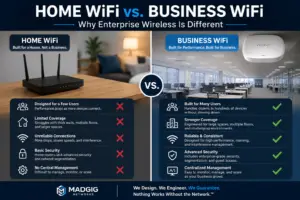
Why Consumer Equipment Fails in Commercial Environments
Consumer networking products are built around one goal: easy home installation.
The design assumptions are reasonable for a home — a handful of users, a few TVs and mobile devices, some smart home gear, occasional remote work. That environment is predictable and low-demand.
Commercial environments are not.
• A marina needs reliable connectivity across large outdoor areas
• A hotel needs hundreds of guests online simultaneously
• A warehouse needs scanners communicating with servers all day without interruption
• A manufacturing facility needs production systems that simply cannot go down
Consumer equipment isn’t designed for any of that.
Coverage vs. Capacity: The Wi-Fi Mistake Most Businesses Make
Most people judge Wi-Fi by signal bars. Businesses can’t afford to stop there.
A location can have full signal coverage and still deliver a terrible user experience — because too many devices are competing for airtime at the same time.
Professional commercial wireless design accounts for:
• Coverage analysis
• Capacity planning
• Device density
• Roaming requirements
• Interference management
Business Wi-Fi isn’t about making bars appear on a phone. It’s about supporting operational requirements at scale.
Why Commercial Networks Require Redundancy
Most homes run on a single internet connection. If it goes down, people wait.
Businesses often can’t afford to wait. A properly designed commercial network may include:
• Primary fiber internet
• Secondary cable or fixed wireless
• 5G failover or Satellite
• Automated failover switching
The reason isn’t complexity for its own sake. It’s simple math: the cost of downtime exceeds the cost of redundancy.
What Does a Commercial Network Engineer Actually Sell?
Not routers. Not switches. Not access points.
The real product is business continuity.
Reliable internet. Reliable Wi-Fi. Reliable communications. Reliable operations.
The technology is the tool. The outcome is what businesses are actually buying — and what they depend on every single day.
The Bottom Line
Residential and commercial networking share similar technology but serve completely different purposes.
A home network provides convenience. A commercial network supports operations, productivity, revenue, and customer experience.
When business owners start evaluating their network based on operational impact instead of equipment cost, they ask better questions — and better questions lead to better outcomes.
Because at the end of the day, nothing works without the network.